 NewsDiff
JetBrains intros Central agentic AI, retires Code With Me
Headline changed Content changed
Changes
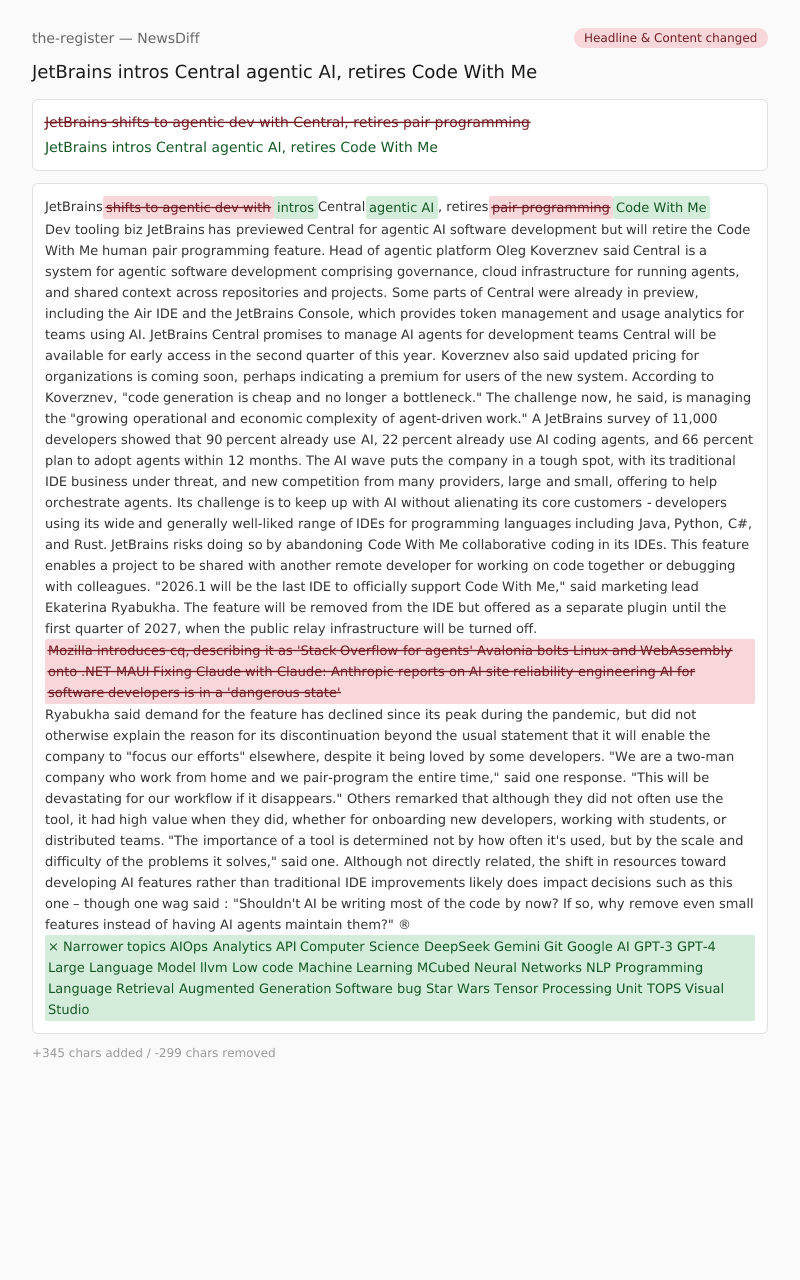
JetBrains shifts to agentic dev withintros Central agentic AI, retires pair programmingCode With Me
Dev tooling biz JetBrains has previewed Central for agentic AI software development but will retire the Code With Me human pair programming feature.
Head of agentic platform Oleg Koverznev said Central is a system for agentic software development comprising governance, cloud infrastructure for running agents, and shared context across repositories and projects.
Some parts of Central were already in preview, including the Air IDE and the JetBrains Console, which provides token management and usage analytics for teams using AI.
JetBrains Central promises to manage AI agents for development teams
Central will be available for early access in the second quarter of this year. Koverznev also said updated pricing for organizations is coming soon, perhaps indicating a premium for users of the new system.
According to Koverznev, "code generation is cheap and no longer a bottleneck." The challenge now, he said, is managing the "growing operational and economic complexity of agent-driven work."
A JetBrains survey of 11,000 developers showed that 90 percent already use AI, 22 percent already use AI coding agents, and 66 percent plan to adopt agents within 12 months.
The AI wave puts the company in a tough spot, with its traditional IDE business under threat, and new competition from many providers, large and small, offering to help orchestrate agents. Its challenge is to keep up with AI without alienating its core customers - developers using its wide and generally well-liked range of IDEs for programming languages including Java, Python, C#, and Rust.
JetBrains risks doing so by abandoning Code With Me collaborative coding in its IDEs. This feature enables a project to be shared with another remote developer for working on code together or debugging with colleagues.
"2026.1 will be the last IDE to officially support Code With Me," said marketing lead Ekaterina Ryabukha. The feature will be removed from the IDE but offered as a separate plugin until the first quarter of 2027, when the public relay infrastructure will be turned off.
Mozilla introduces cq, describing it as 'Stack Overflow for agents'
Avalonia bolts Linux and WebAssembly onto .NET MAUI
Fixing Claude with Claude: Anthropic reports on AI site reliability engineering
AI for software developers is in a 'dangerous state'
Ryabukha said demand for the feature has declined since its peak during the pandemic, but did not otherwise explain the reason for its discontinuation beyond the usual statement that it will enable the company to "focus our efforts" elsewhere, despite it being loved by some developers.
"We are a two-man company who work from home and we pair-program the entire time," said one response. "This will be devastating for our workflow if it disappears."
Others remarked that although they did not often use the tool, it had high value when they did, whether for onboarding new developers, working with students, or distributed teams. "The importance of a tool is determined not by how often it's used, but by the scale and difficulty of the problems it solves," said one.
Although not directly related, the shift in resources toward developing AI features rather than traditional IDE improvements likely does impact decisions such as this one – though one wag said : "Shouldn't AI be writing most of the code by now? If so, why remove even small features instead of having AI agents maintain them?" ®
×
Narrower topics
AIOps
Analytics
API
Computer Science
DeepSeek
Gemini
Git
Google AI
GPT-3
GPT-4
Large Language Model
llvm
Low code
Machine Learning
MCubed
Neural Networks
NLP
Programming Language
Retrieval Augmented Generation
Software bug
Star Wars
Tensor Processing Unit
TOPS
Visual Studio