 NewsDiff
NASA's lunar reboot is long on ambition, short on answers
Content changed
Changes
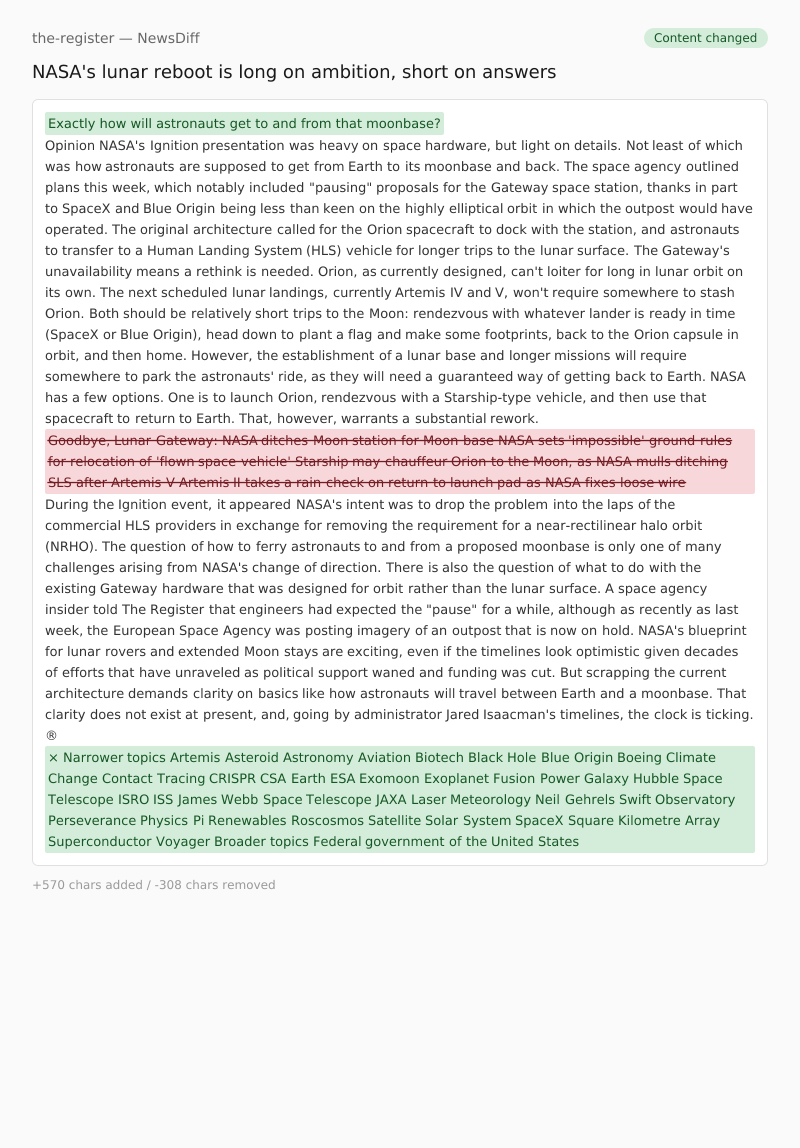
Exactly how will astronauts get to and from that moonbase?
Opinion NASA's Ignition presentation was heavy on space hardware, but light on details. Not least of which was how astronauts are supposed to get from Earth to its moonbase and back.
The space agency outlined plans this week, which notably included "pausing" proposals for the Gateway space station, thanks in part to SpaceX and Blue Origin being less than keen on the highly elliptical orbit in which the outpost would have operated.
The original architecture called for the Orion spacecraft to dock with the station, and astronauts to transfer to a Human Landing System (HLS) vehicle for longer trips to the lunar surface. The Gateway's unavailability means a rethink is needed. Orion, as currently designed, can't loiter for long in lunar orbit on its own.
The next scheduled lunar landings, currently Artemis IV and V, won't require somewhere to stash Orion. Both should be relatively short trips to the Moon: rendezvous with whatever lander is ready in time (SpaceX or Blue Origin), head down to plant a flag and make some footprints, back to the Orion capsule in orbit, and then home.
However, the establishment of a lunar base and longer missions will require somewhere to park the astronauts' ride, as they will need a guaranteed way of getting back to Earth.
NASA has a few options. One is to launch Orion, rendezvous with a Starship-type vehicle, and then use that spacecraft to return to Earth. That, however, warrants a substantial rework.
Goodbye, Lunar Gateway: NASA ditches Moon station for Moon base
NASA sets 'impossible' ground rules for relocation of 'flown space vehicle'
Starship may chauffeur Orion to the Moon, as NASA mulls ditching SLS after Artemis V
Artemis II takes a rain check on return to launch pad as NASA fixes loose wire
During the Ignition event, it appeared NASA's intent was to drop the problem into the laps of the commercial HLS providers in exchange for removing the requirement for a near-rectilinear halo orbit (NRHO).
The question of how to ferry astronauts to and from a proposed moonbase is only one of many challenges arising from NASA's change of direction. There is also the question of what to do with the existing Gateway hardware that was designed for orbit rather than the lunar surface.
A space agency insider told The Register that engineers had expected the "pause" for a while, although as recently as last week, the European Space Agency was posting imagery of an outpost that is now on hold.
NASA's blueprint for lunar rovers and extended Moon stays are exciting, even if the timelines look optimistic given decades of efforts that have unraveled as political support waned and funding was cut. But scrapping the current architecture demands clarity on basics like how astronauts will travel between Earth and a moonbase.
That clarity does not exist at present, and, going by administrator Jared Isaacman's timelines, the clock is ticking. ®
×
Narrower topics
Artemis
Asteroid
Astronomy
Aviation
Biotech
Black Hole
Blue Origin
Boeing
Climate Change
Contact Tracing
CRISPR
CSA
Earth
ESA
Exomoon
Exoplanet
Fusion Power
Galaxy
Hubble Space Telescope
ISRO
ISS
James Webb Space Telescope
JAXA
Laser
Meteorology
Neil Gehrels Swift Observatory
Perseverance
Physics
Pi
Renewables
Roscosmos
Satellite
Solar System
SpaceX
Square Kilometre Array
Superconductor
Voyager
Broader topics
Federal government of the United States