 NewsDiff
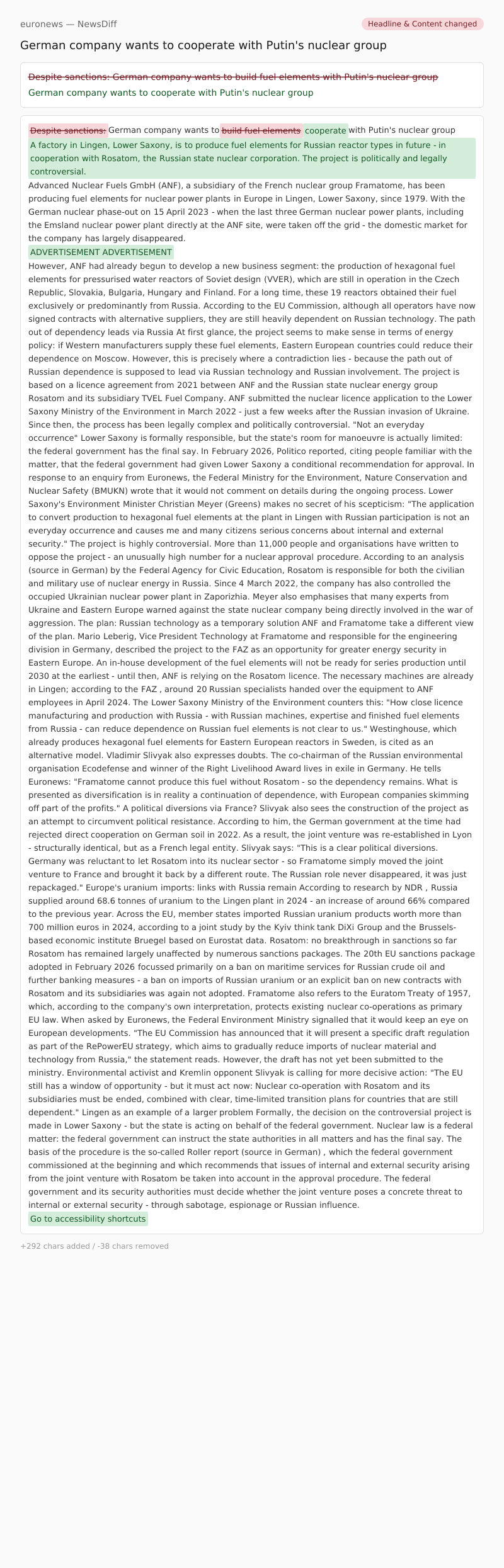
German company wants to cooperate with Putin's nuclear group
Headline changed Content changed
Changes
A factory in Lingen, Lower Saxony, is to produce fuel elements for Russian reactor types in future - in cooperation with Rosatom, the Russian state nuclear corporation. The project is politically and legally controversial.
Advanced Nuclear Fuels GmbH (ANF), a subsidiary of the French nuclear group Framatome, has been producing fuel elements for nuclear power plants in Europe in Lingen, Lower Saxony, since 1979. With the German nuclear phase-out on 15 April 2023 - when the last three German nuclear power plants, including the Emsland nuclear power plant directly at the ANF site, were taken off the grid - the domestic market for the company has largely disappeared.
ADVERTISEMENT
ADVERTISEMENT
However, ANF had already begun to develop a new business segment: the production of hexagonal fuel elements for pressurised water reactors of Soviet design (VVER), which are still in operation in the Czech Republic, Slovakia, Bulgaria, Hungary and Finland. For a long time, these 19 reactors obtained their fuel exclusively or predominantly from Russia. According to the EU Commission, although all operators have now signed contracts with alternative suppliers, they are still heavily dependent on Russian technology.
The path out of dependency leads via Russia
At first glance, the project seems to make sense in terms of energy policy: if Western manufacturers supply these fuel elements, Eastern European countries could reduce their dependence on Moscow. However, this is precisely where a contradiction lies - because the path out of Russian dependence is supposed to lead via Russian technology and Russian involvement.
The project is based on a licence agreement from 2021 between ANF and the Russian state nuclear energy group Rosatom and its subsidiary TVEL Fuel Company. ANF submitted the nuclear licence application to the Lower Saxony Ministry of the Environment in March 2022 - just a few weeks after the Russian invasion of Ukraine. Since then, the process has been legally complex and politically controversial.
"Not an everyday occurrence"
Lower Saxony is formally responsible, but the state's room for manoeuvre is actually limited: the federal government has the final say. In February 2026, Politico reported, citing people familiar with the matter, that the federal government had given Lower Saxony a conditional recommendation for approval.
In response to an enquiry from Euronews, the Federal Ministry for the Environment, Nature Conservation and Nuclear Safety (BMUKN) wrote that it would not comment on details during the ongoing process.
Lower Saxony's Environment Minister Christian Meyer (Greens) makes no secret of his scepticism: "The application to convert production to hexagonal fuel elements at the plant in Lingen with Russian participation is not an everyday occurrence and causes me and many citizens serious concerns about internal and external security."
The project is highly controversial. More than 11,000 people and organisations have written to oppose the project - an unusually high number for a nuclear approval procedure.
According to an analysis (source in German) by the Federal Agency for Civic Education, Rosatom is responsible for both the civilian and military use of nuclear energy in Russia. Since 4 March 2022, the company has also controlled the occupied Ukrainian nuclear power plant in Zaporizhia. Meyer also emphasises that many experts from Ukraine and Eastern Europe warned against the state nuclear company being directly involved in the war of aggression.
The plan: Russian technology as a temporary solution
ANF and Framatome take a different view of the plan. Mario Leberig, Vice President Technology at Framatome and responsible for the engineering division in Germany, described the project to the FAZ as an opportunity for greater energy security in Eastern Europe. An in-house development of the fuel elements will not be ready for series production until 2030 at the earliest - until then, ANF is relying on the Rosatom licence. The necessary machines are already in Lingen; according to the FAZ , around 20 Russian specialists handed over the equipment to ANF employees in April 2024.
The Lower Saxony Ministry of the Environment counters this: "How close licence manufacturing and production with Russia - with Russian machines, expertise and finished fuel elements from Russia - can reduce dependence on Russian fuel elements is not clear to us." Westinghouse, which already produces hexagonal fuel elements for Eastern European reactors in Sweden, is cited as an alternative model.
Vladimir Slivyak also expresses doubts. The co-chairman of the Russian environmental organisation Ecodefense and winner of the Right Livelihood Award lives in exile in Germany. He tells Euronews: "Framatome cannot produce this fuel without Rosatom - so the dependency remains. What is presented as diversification is in reality a continuation of dependence, with European companies skimming off part of the profits."
A political diversions via France?
Slivyak also sees the construction of the project as an attempt to circumvent political resistance. According to him, the German government at the time had rejected direct cooperation on German soil in 2022. As a result, the joint venture was re-established in Lyon - structurally identical, but as a French legal entity. Slivyak says: "This is a clear political diversions. Germany was reluctant to let Rosatom into its nuclear sector - so Framatome simply moved the joint venture to France and brought it back by a different route. The Russian role never disappeared, it was just repackaged."
Europe's uranium imports: links with Russia remain
According to research by NDR , Russia supplied around 68.6 tonnes of uranium to the Lingen plant in 2024 - an increase of around 66% compared to the previous year. Across the EU, member states imported Russian uranium products worth more than 700 million euros in 2024, according to a joint study by the Kyiv think tank DiXi Group and the Brussels-based economic institute Bruegel based on Eurostat data.
Rosatom: no breakthrough in sanctions so far
Rosatom has remained largely unaffected by numerous sanctions packages. The 20th EU sanctions package adopted in February 2026 focussed primarily on a ban on maritime services for Russian crude oil and further banking measures - a ban on imports of Russian uranium or an explicit ban on new contracts with Rosatom and its subsidiaries was again not adopted.
Framatome also refers to the Euratom Treaty of 1957, which, according to the company's own interpretation, protects existing nuclear co-operations as primary EU law.
When asked by Euronews, the Federal Environment Ministry signalled that it would keep an eye on European developments. "The EU Commission has announced that it will present a specific draft regulation as part of the RePowerEU strategy, which aims to gradually reduce imports of nuclear material and technology from Russia," the statement reads. However, the draft has not yet been submitted to the ministry.
Environmental activist and Kremlin opponent Slivyak is calling for more decisive action: "The EU still has a window of opportunity - but it must act now: Nuclear co-operation with Rosatom and its subsidiaries must be ended, combined with clear, time-limited transition plans for countries that are still dependent."
Lingen as an example of a larger problem
Formally, the decision on the controversial project is made in Lower Saxony - but the state is acting on behalf of the federal government. Nuclear law is a federal matter: the federal government can instruct the state authorities in all matters and has the final say. The basis of the procedure is the so-called Roller report (source in German) , which the federal government commissioned at the beginning and which recommends that issues of internal and external security arising from the joint venture with Rosatom be taken into account in the approval procedure.
The federal government and its security authorities must decide whether the joint venture poses a concrete threat to internal or external security - through sabotage, espionage or Russian influence.
Go to accessibility shortcuts